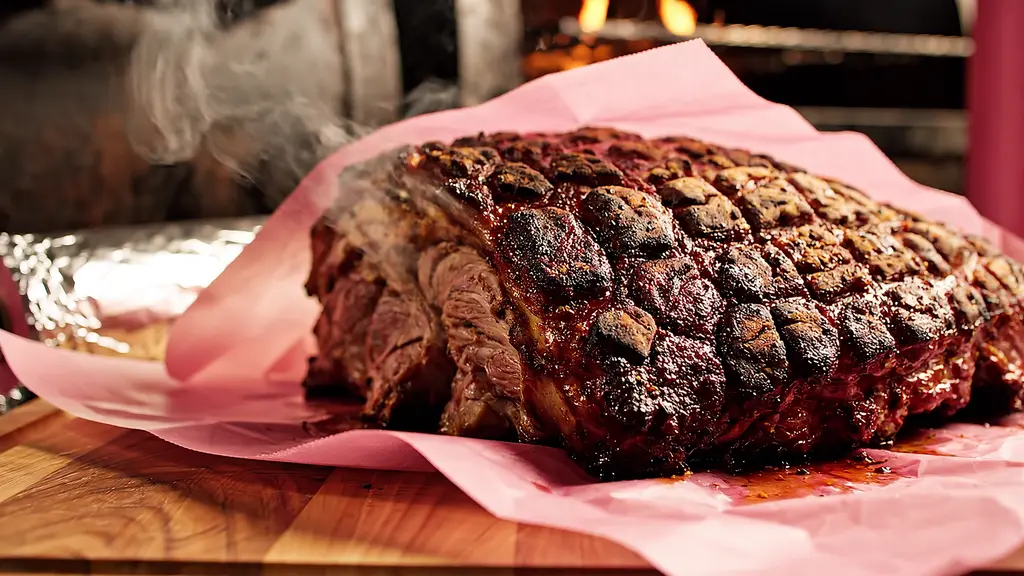
When a brisket or pork shoulder stops climbing around 150°F–175°F, it can feel as though the smoker has quit. Often, the pit is doing exactly what it should. You’re watching the stall: a period when evaporative cooling at the meat’s surface slows the internal temperature rise.
The stall does not occur at one exact temperature, last a fixed number of hours, or mean that the meat is unsafe. Its timing changes with the cut, cooker, humidity, airflow, and how much moisture is reaching the surface.
What is happening?
As meat cooks, moisture migrates toward the outside. Evaporation removes heat from the surface. For a time, that cooling can offset part of the heat entering the meat, slowing the thermometer’s climb. Eventually, the balance shifts and the internal temperature starts rising more quickly again.
Collagen changes and fat rendering continue during a long cook, but evaporative cooling is an important explanation for the familiar temperature plateau. There is no need to panic or raise the smoker to an extreme setting.
Your three options
| Method | Main advantage | Main trade-off |
|---|---|---|
| No wrap | Firm bark and uninterrupted smoke exposure | More surface drying and a potentially longer cook |
| Uncoated, unwaxed food-grade butcher paper | Reduces drying while allowing some moisture movement | Can still soften bark; wrapping quality matters |
| Heavy-duty aluminum foil | Retains moisture and can shorten the cook | More steaming; bark is likely to soften |
Paper does not magically keep bark “crunchy,” and foil is not automatically wrong. Choose based on your timeline and the texture you want.


When and how to wrap
- Wait for the bark to set. A dark, dry-looking exterior that doesn’t smear easily is a better cue than a hard “wrap at 165°F” rule.
- Use safe materials. Choose food-grade, unwaxed, uncoated butcher paper or appropriate heavy-duty foil. Do not wrap food in waxed craft paper or packaging not approved for cooking.
- Wrap snugly. Limit big air pockets, but don’t crush the meat or tear the paper.
- Monitor after wrapping. Cooking often accelerates; check more frequently as the meat approaches tenderness.
- Finish by feel. Brisket is often probe-tender near 195°F–205°F, but no single number guarantees a tender flat. Pork shoulder intended for shredding is also commonly cooked into this range.
You can see the stall in context in the Texas brisket guide and the Weekend Smoke Guide.
Avoid these mistakes
- Wrapping too early: Can trap steam before the bark sets.
- Increasing the fire dramatically: May scorch the outside while the center catches up.
- Relying only on 203°F: Probe several spots. A tough section needs more time even if the number looks right.
- Ignoring safe holding: Once the cook is done, keep finished meat at 140°F or hotter if holding it warm, or cool it promptly for refrigeration.
Best first experiment: Cook two comparable pork shoulders at the same grate temperature. Wrap one after the bark sets and leave the other unwrapped. Compare actual cook time, surface texture, and moisture. Your own grill is the best teacher.